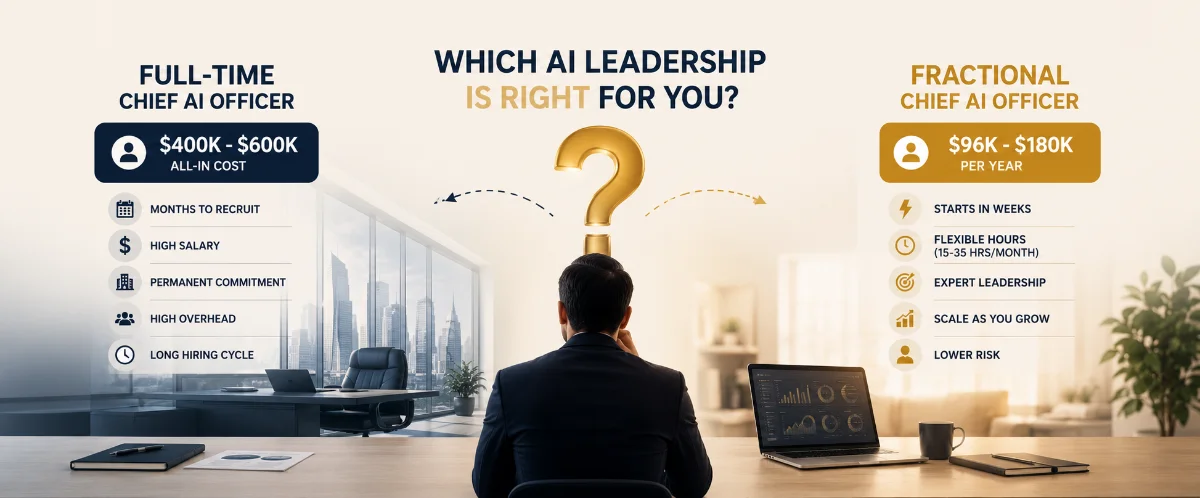
- A full-time Chief AI Officer typically costs $400K-$600K all-in and takes months to recruit.
- A fractional CAIO provides senior AI ownership part-time — roughly 15-35 hours a month — at a fraction of the cost, starting in weeks.
- Hire full-time when the role is well-defined and the workload is permanent; go fractional when you need senior ownership now but the role is still emerging.
- Many organisations are best served by sequencing: start fractional, prove the value, then hire.
A full-time Chief AI Officer costs $400K–$600K all-in and takes months to recruit. A fractional leader costs roughly $96K–$180K a year and can start in weeks. But cost, while real, is the least interesting part of the decision. The more important question is what your organisation actually needs from AI leadership right now — and when.
What you actually need, and when
Most organisations need senior AI judgement long before they need — or can justify — a permanent executive on the payroll. They have pilots that need to become production systems, a board that wants a credible roadmap, vendors that need managing, and adoption that is not happening on its own. All of that requires ownership. None of it necessarily requires a full-time hire on day one.
The risk of hiring too early is committing to a $500K role before the mandate of that role is clear, and watching the hire spend their first six months defining their own job. The risk of waiting is drift: stalled pilots, lost time against the UAE mandate clock, and a competitor who moved first.
Hire full-time when the role is well-defined and the workload is permanent. Go fractional when you need senior ownership now, but the shape of the job is still emerging.
What a fractional CAIO actually does
A fractional Chief AI Officer provides senior AI leadership on a part-time basis — typically 15 to 35 hours a month — and owns the things that otherwise fall through the cracks:
- The AI strategy and roadmap, kept tied to commercial outcomes
- Governance, responsible-AI policy and risk oversight
- Use-case prioritisation and the initiative portfolio
- Vendor and delivery-partner selection and coordination
- Adoption tracking and the change work that makes AI stick
- Board-level reporting and, in the UAE, mandate-compliance progress
Where fractional wins
- Speed. No recruitment cycle — ownership starts in weeks, which matters when the mandate clock is running.
- Flexibility. Monthly terms scaled to the work in front of you, not a permanent fixed cost.
- Experience density. A senior practitioner who has deployed AI across industries and countries, without a full-time price tag.
Where full-time wins
- A large, permanent AI organisation that needs day-to-day, in-house leadership
- Deep, constant internal stakeholder management that benefits from a constant physical presence
- A mandate stable and broad enough to justify a lasting executive role
The honest answer: sequence it
For many companies the right answer is not either/or but a sequence. Start fractional to prove the value and shape the role — let the actual work define what a permanent CAIO would need to own — then hire full-time once the mandate, and the business case for it, are clear. You get senior ownership immediately, avoid an expensive premature hire, and arrive at the full-time decision with evidence instead of guesswork.
That is exactly how I structure fractional Chief AI Officer engagements: senior ownership now, on flexible monthly terms, with a deliberate path toward whatever the right permanent structure turns out to be.